

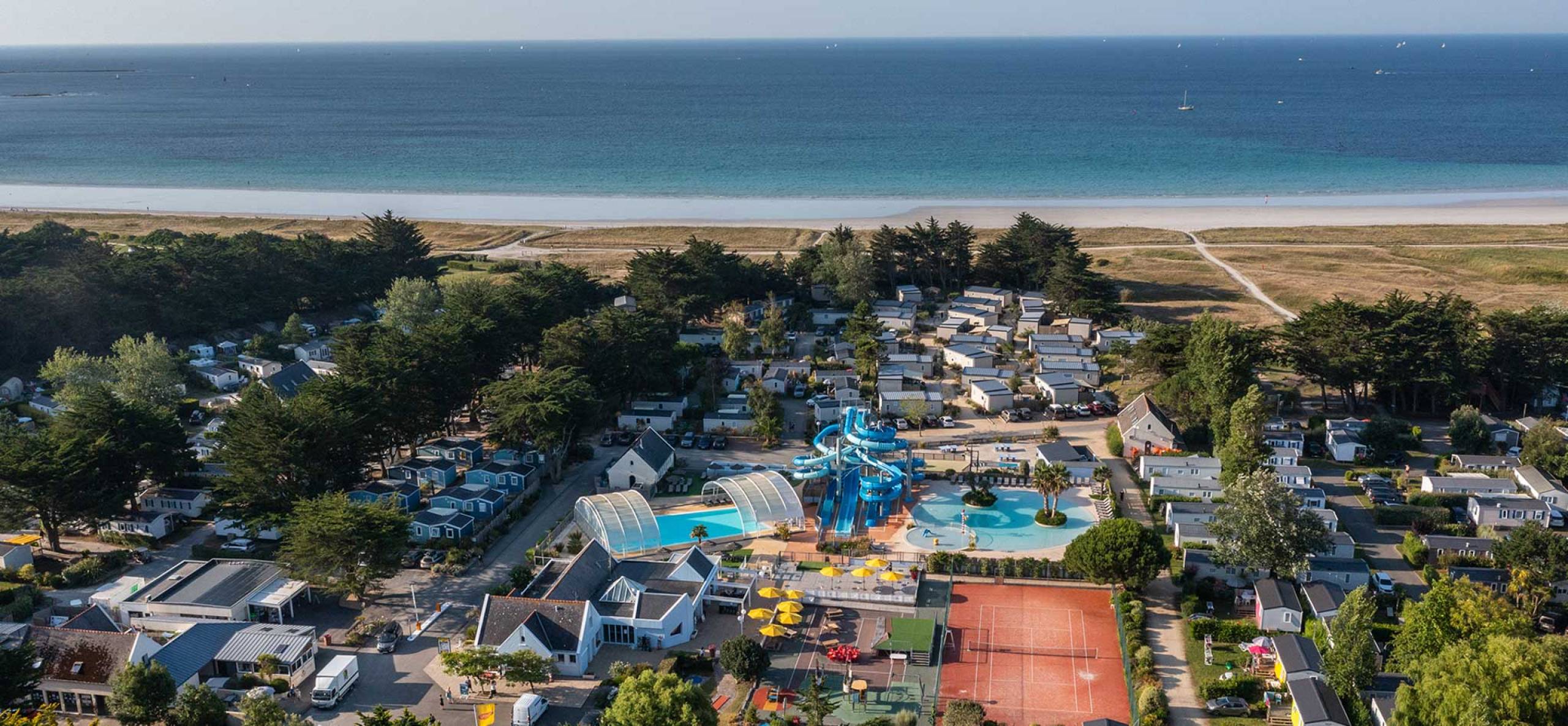
The Plage du Ster, south of Penmarc'h, uncovers a wide stretch of shore at low tide. It is 50 metres from the campsite, and the Pays Bigouden tourist office runs guided foreshore discovery walks there.
The best shellfish gathering spots in Finistère
Damp sand under your boots, a rock pool stirring, a bucket slowly filling up. In Finistère, shellfish gathering happens at low tide, ideally during spring tides, with family or friends. The first beach is just 50 metres from the campsite: the Plage du Ster, in Penmarc'h. The other spots in this selection are a 35-minute to 1 hour 10-minute drive away.
Shellfish gatherers of all ages, grab your buckets. Clams, cockles, velvet crabs, shrimps, winkles: every foreshore has its own residents, in the sand, in rock pools or under the rocks.

The Plage du Ster in Penmarc'h (50 metres from the campsite)
Pull on your boots, cross the dune, and the foreshore is right there. The Plage du Ster stretches for almost 4 kilometres south of Penmarc'h, facing due south towards the Étocs archipelago. At low tide, a wide stretch of shore is uncovered, drawing shellfish gatherers from all over the Pays Bigouden.
Among the rocks at either end of the beach, you will find winkles, limpets and a few crustaceans. In the sandy areas, clams, depending on the beds the tide uncovers. For a first outing, the Pays Bigouden tourist office runs guided foreshore discovery walks during the season.
You walk back, bucket in hand, to the terrace of your cottage. Tide times are posted at reception.
L'Île-Tudy (35 minutes from the campsite)
A peninsula in the Pays Bigouden, L'Île-Tudy is one of the favourite spots for shellfish gathering in Finistère. Almost entirely edged with fine sand, it can be explored on foot, and there is enough space for everyone to gather at their own pace. It is one of the best spots for a family outing: children have room to explore, and the varied foreshore holds a new discovery at every step.
Cockles, clams, winkles, oysters and shrimps are what gatherers look for here. An encouraging place for beginners, young and old alike, provided you respect the minimum sizes and quotas for each species. And whatever you bring back, the day is well worth it: the old fishing village with its colourful little houses, the beaches, the dunes and the sunsets over the estuary of the Pont-l'Abbé river.
The Plage du Ris in Douarnenez (45 minutes from the campsite)
The Plage du Ris is a wonderful playground for trying shellfish gathering for the first time. Tucked at the end of a bay and shared between Kerlaz and Douarnenez, it has been spared from property development. A row of small huts overlooks the beach and gives it a charm all of its own.
Popular with surfers in winter, the Plage du Ris is also well known to shellfish gatherers, whatever the season. At low tide, the water recedes a very long way, revealing a wide, flat stretch of fine sand: ideal conditions for beginners, including children, as long as you keep an eye on the incoming tide.
Questélan beach and Saint-Léger cove in Riec-sur-Bélon (1 hour 10 minutes from the campsite)
Between the Aven and Bélon rivers, Riec-sur-Bélon is the home of the famous Bélon flat oyster, a source of local pride, just like lobster in cream sauce. On Questélan beach or in Saint-Léger cove, you are unlikely to come across the latter, but small crabs, razor clams and winkles are there to be found. Both spots appeal to experienced gatherers, who enjoy lifting stones to surprise the crustaceans beneath.
The oysters in the oyster beds, however, belong to the oyster farmers: they are never to be picked.
Moëlan-sur-Mer (1 hour 10 minutes from the campsite)
Cut through by rias that seem to plunge inland, Moëlan-sur-Mer has a beauty all of its own. The paths along the rivers and the coast lead to some much-loved shellfish gathering spots: the beaches of Trénez and Malachape at Brigneau, and the Pointe de Kersecol and Baz Couz at Merrien. Young and old alike enjoy superb scenery here, bucket in hand.
The golden rules of shellfish gathering
Shellfish gathering is possible all year round in Finistère, and spring tides remain the best time to go. You need very little equipment: a pair of boots, a windproof jacket, a hand net, a small spade or hoe, a bucket, a pair of gloves and a measuring gauge to check your catch.
For your safety and for responsible gathering, we recommend that you:
• check the health status of the site on the Pêche à pied responsable interactive map, any current bans with the Finistère prefecture or the town hall, and the permitted areas with the local tourist offices; • look up the tide times and tidal coefficients for your spot, for example on maree.info (in French), as well as the weather forecast for the day; • respect the minimum sizes, quotas and seasons for each species, set out in the annual summary of the regulations published by the Finistère maritime authority (DDTM); • always put back any rock you have turned over or lifted: it shelters a whole world; • never gather from oyster or mussel beds, which belong to professional farmers; • never go alone, and tell someone where you are going; • head back at least 30 minutes before the tide turns, so you are not caught out by currents that are often strong; • keep your shellfish and crustaceans alive and cool until you cook them, and soak those that need to purge their sand.
In a sea emergency, call 196.
After gathering, back at the campsite
Bucket rinsed, boots left on the terrace, the best part is still to come: cooking your catch in your cottage after a day outdoors. From the campsite, the Plage du Ster is just 50 metres away and the GR34 runs along the coast: low tide is within walking distance. A quick look at the tide times posted at reception, and you are ready to go.
Your questions about shellfish gathering in Finistère
Are there shellfish gathering bans in Finistère?
Yes, regularly. The prefecture issues temporary closure orders when tests reveal contamination, then lifts them once the situation is back to normal. Several areas were affected in 2026. Before every outing, check the Pêche à pied responsable interactive map (run by the regional health agency and Ifremer), the current orders on the Finistère prefecture website, or the local town hall.
Do I need a permit for recreational shellfish gathering?
No, no permit is required. The rules apply to everyone, however: minimum sizes, quotas per species, permitted tools and open areas.
When is the best time to go shellfish gathering?
At low tide, ideally during spring tides, when the sea goes out the furthest. Tide times can vary by almost two hours between the north and the south of Finistère: check those for your spot on maree.shom.fr. The higher the coefficient, the faster the tide comes back in: head back at least 30 minutes before it turns.
Can I go shellfish gathering with children?
Yes. Flat sandy beaches such as the Plage du Ris are a good place to start. Stay together, keep an eye on the tide and teach them to put every rock back in place.
How should I keep my catch?
Keep shellfish and crustaceans alive and cool until cooking. Soak those that contain sand, such as cockles and clams, in seawater to purge them, and eat them quickly.